Every week, another company announces AI-driven efficiency. Hiring freezes. Flatter organizations. Fewer frontline roles. In many cases, the economics is real.
Organizations are discovering that AI can handle an enormous amount of routine work. Some leaders are even requiring teams to prove AI cannot do a task before approving additional headcount. In a widely discussed example, Tobi Lütke, CEO of Shopify, stated that teams must show why they "cannot get what they want done using AI" before requesting more people or resources.
But there is an important assumption hiding underneath many of these conversations...
That automating work also eliminates responsibility. It doesn't.
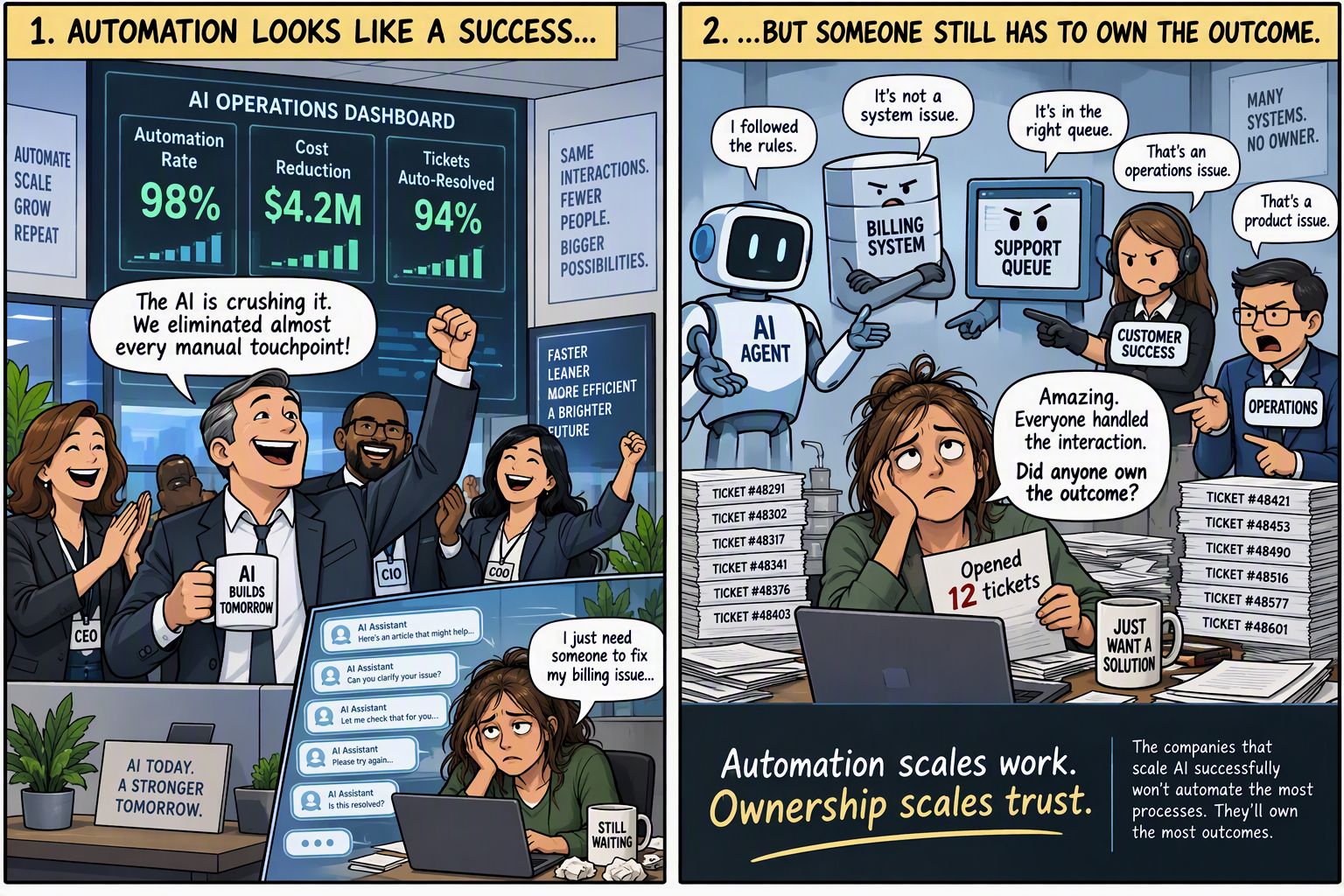
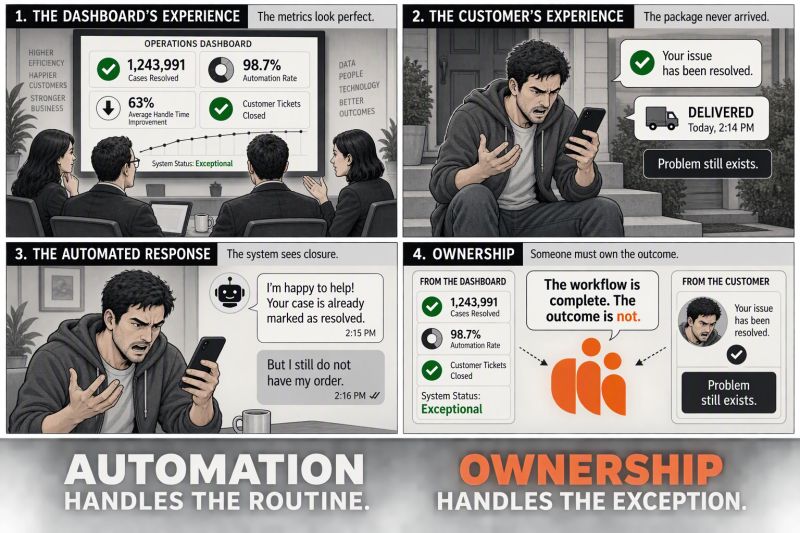
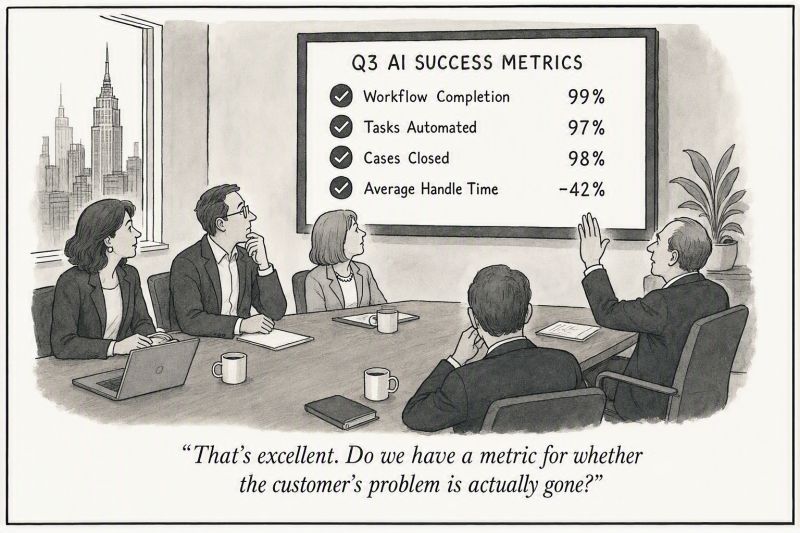
When an AI successfully handles 90% of customer interactions, the focus naturally shifts to the cost savings. But customers don't experience percentages.
They experience exceptions. The flight that wasn't rebooked correctly. The payment that disappeared between systems. The order that shows "Delivered" but never arrived. The policy that made sense in the workflow but failed in the real world.
Ironically, the more successful AI becomes, the more visible these moments become. Because scale magnifies exceptions.
A million successful interactions are invisible... the unresolved one is memorable.
That's why the future isn't AI versus humans. And it isn't humans versus efficiency.
The organizations that win will be the ones that understand a simple truth: Automation reduces workload. It does not eliminate ownership.
In fact, ownership becomes more important than automation scales. Many organizations are redesigning their workforce around AI. Some are reducing roles, while others are repositioning human responsibilities toward higher-value judgment and exception management.
The question isn't: "How many people can AI replace?"
The more important question is: "Who owns the outcome when the workflow reaches its limits?"
Because customers don't care whether a failure was human or AI. They care whether their flight gets rebooked, their payment is found, or the package gets delivered. They care that someone owns the resolution.
Reference: Palmer, Annie. "Shopify CEO says staffers need to prove jobs can't be done by AI before asking for more headcount." CNBC, April 7, 2025